
Wastewater 101
How Bartlesville’s wastewater system works — and the major improvements underway to keep it reliable
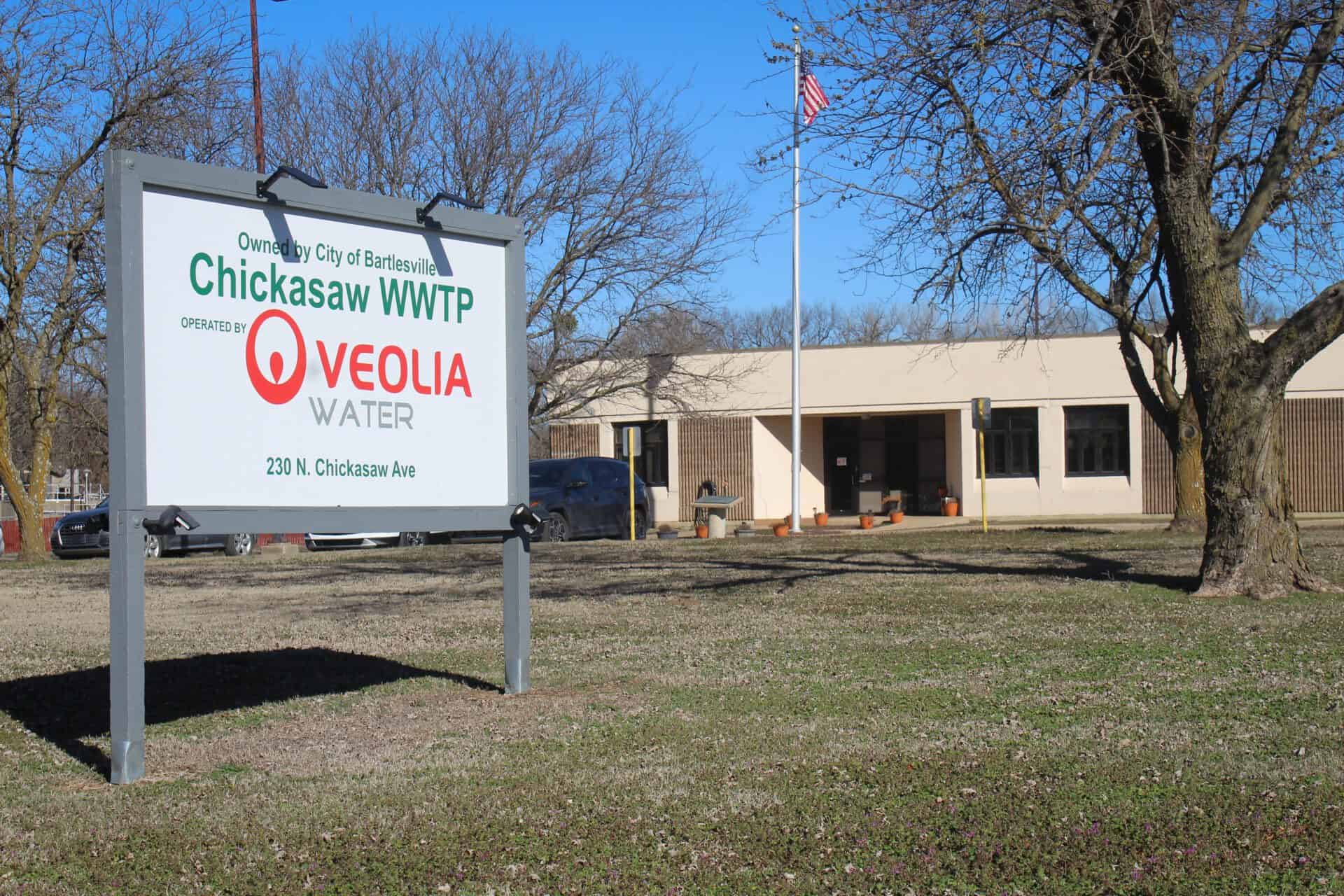
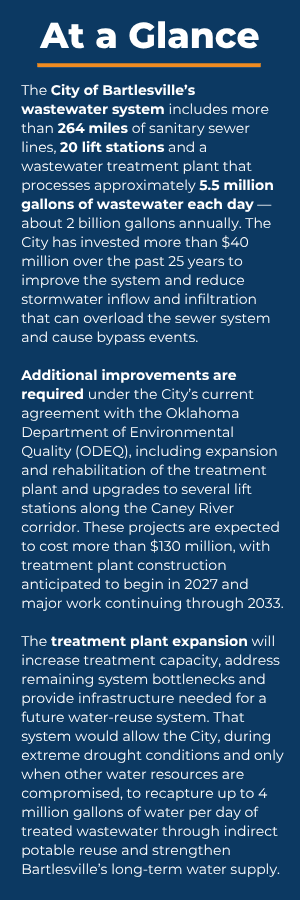
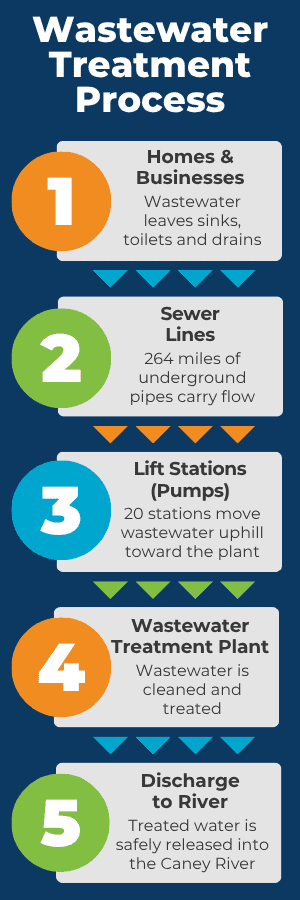
The City of Bartlesville's wastewater system consists of more than 264 miles of sanitary sewer lines, ranging from four to 42 inches in size, and includes a wastewater treatment plant and 20 lift stations, sometimes called "pump" stations
The system processes approximately 5.5 million gallons of wastewater per day (mgd), or 2 billion gallons each year. Last year, more than 4.7 million gallons of biosolids were land applied, which is equivalent to 596 dry tons of material.
An expansion of the plant is required to meet Oklahoma Department of Environmental Quality (ODEQ) requirements. This will increase the plant's capacity for treatment, from 15 mgd to 26 mgd, and enable the City to implement the water reuse system in the event of emergency circumstances. Construction on the expansion is expected to begin in 2027 and conclude in 2031.
CONSENT ORDERS
A consent order is an agreement between the City and ODEQ that outlines specific deficiencies and sets deadlines for resolving them, while allowing the City flexibility to determine time frames for the various tasks. Violation of a consent order carries a monetary fine amounting to hundreds of dollars each day the conditions of the order are not met.
The City has for decades been under consent orders from the ODEQ to eliminate “bypass events,” which typically occur during periods of heavy rainfall, when stormwater enters the sewer system through missing clean-out caps, cracked pipes or manholes, causing the system to exceed capacity and become overloaded. When this occurs, sewage can back up and “daylight” at various locations, resulting in untreated wastewater bypassing the treatment process and being discharged to the environment.
This problem was first identified in the mid-1980s and resulted in a consent decree in August 1989 from the Environmental Protection Agency (EPA) to comply with the National Pollutant Discharge Elimination System (NPDES) laws created in 1972 by the Federal Clean Water Act. The decree required the City to make improvements to the Wastewater Treatment Plant and collection system to reduce the inflow/infiltration of stormwater from entering the City’s sanitary sewer system.
The City remained under intermittent consent orders and decrees throughout the 1990s, which eventually required operations at the wastewater treatment plant to be contracted to a third party. Veolia Water North America. Currently, Veolia operates the wastewater treatment plant and 20 lift stations.
In 2003, the City and the ODEQ agreed to a consent order for improvements to the collection system to eliminate bypass events. The ODEQ amended this consent order in 2006 — and again in 2008 — to include additional tasks to improve the collection system.
When this order was complete, in 2013, the ODEQ issued a new consent order, requiring additional improvements to the collection system. That order was complete by July 1, 2019, and required the City to submit a schedule for the engineering design and construction of treatment plant improvements.
The City was operating under a Consent Order issued in 2020 and subsequently modified in 2023. In 2025, the City requested additional time to complete several tasks required under the 2020 Consent Order. As a result, a new Consent Order was issued and approved in May 2026. (Scroll down for details.)
It is important to note the City of Bartlesville is not alone in this. Cities across the state, from Ada to Wister — as well as the nation — received similar orders from the EPA and continue to do so now through the ODEQ.
TREATMENT PLANT IMPROVEMENTS REQUIRED
A study of the City’s sanitary sewer system, initially conducted in the early 1990s, revealed that storm water was entering the system from both public and private sides. Many private properties had been developed prior to 1990 to allow the discharges of stormwater into the sanitary sewer system, such as footing/foundation drains, roof drains, downspouts, drains from window wells, drains from driveways and from ground water or basement sump pumps.
Through the 1990s, the City worked with private property owners to disconnect these points of entry. These studies also revealed several locations where stormwater was entering the City’s sanitary sewer collection system, primarily through manhole and pipeline defects.
The studies also identified that the wastewater treatment plant and lift stations along the Caney River will eventually become bottlenecks within the wastewater collection and treatment system and would require expansion to eliminate all of the bypasses. Recognizing that significant investment in the wastewater treatment plant would be necessary, a study was started in 2002 looking at the scope of improvements to eliminate the remaining bypasses. While the study was essentially completed in 2004, it was put on hold due to the 2003 consent order. In 2009, once the consent order from 2003 and their subsequent amendments were nearing the end, the facility plan was restarted.
The study, completed in 2010, recommended building a secondary wastewater treatment plant south of town and improving several of the lift stations along the Caney River. The estimated cost of these improvements was $35 million (based on 2010 dollars). Today, that estimate would be significantly higher.
IMPROVEMENTS
Over the past 25 years, the City has spent more than $43 million making required improvements to the system and has significantly reduced stormwater inflow and infiltration as well as improved the capacity of the collection system.
However, additional improvements are required to remove the remaining bypasses. These improvements are quite significant and involve increasing the existing capacity of the sanitary sewer treatment plant and making improvements to the lines and lift stations along the Caney River pump corridor, which starts at Hillcrest Country Club through Shawnee at the Bartlesville High School, where the wastewater is lifted from the south end of the city north to the treatment plant, located on Tuxedo Boulevard. The cost of these remaining improvements is estimated at $130 million.
The scope of the work for the 2013 order targeted improvements around Jane Phillips Elementary School, Bartlesville High School and areas throughout downtown. This work has been completed. The last task on this consent order was to submit a design and construction schedule for improvements to the wastewater treatment plant and pumping corridor, which covers three lift stations starting at Hillcrest Country Club through the high school.
WATER REUSE
In 2019, the City Council approved measures to facilitate the City’s ability to utilize the “Water for 2060 Law,” which allow the City of Bartlesville to recapture treated wastewater and reuse it, after additional treatment, for drinking water.
This project is ready to implement but requires the construction of additional treatment at the wastewater treatment plant, which will occur with the construction/expansion of the wastewater treatment plant, slated to start in 2027 and be complete in 2031.
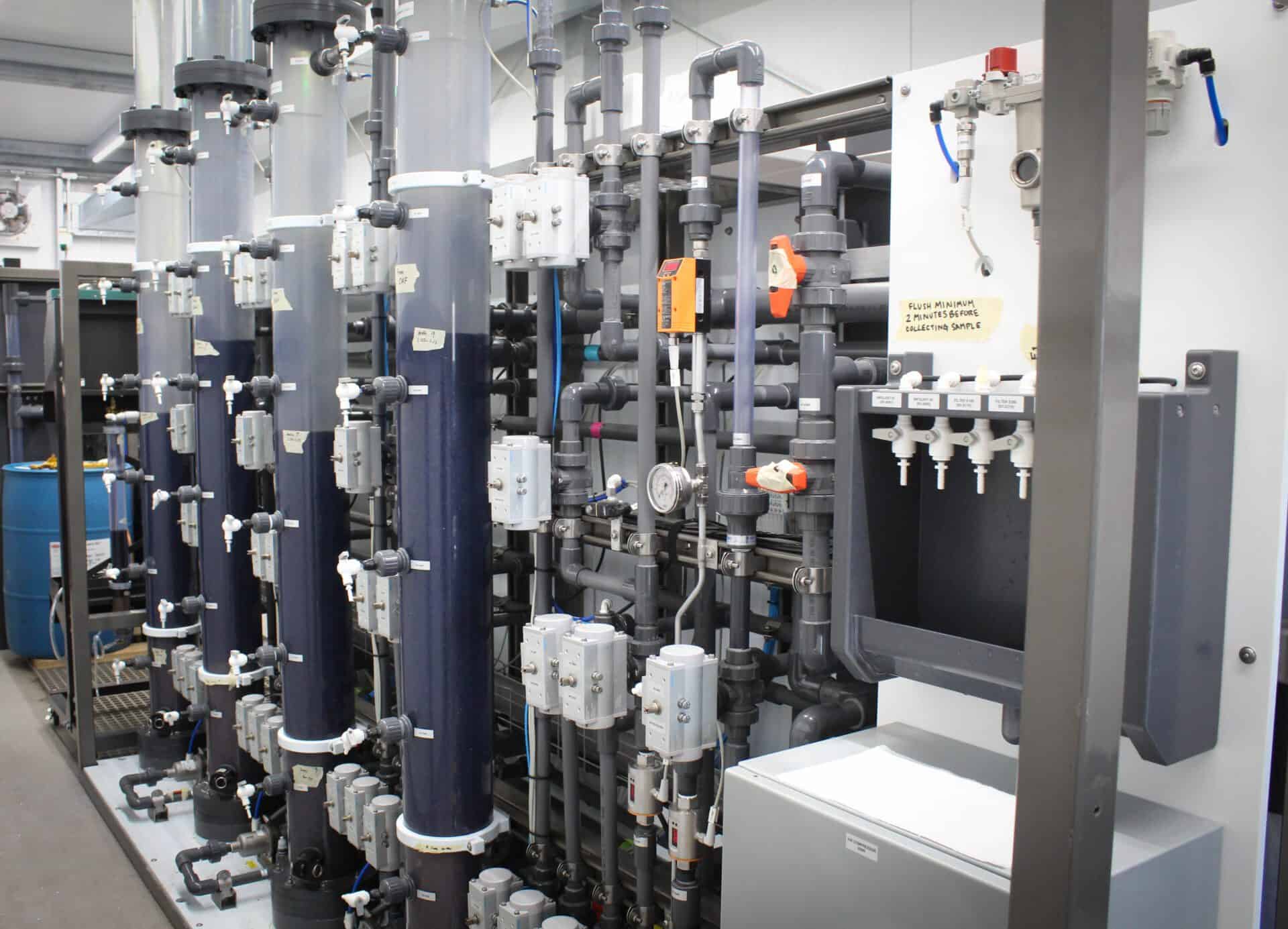
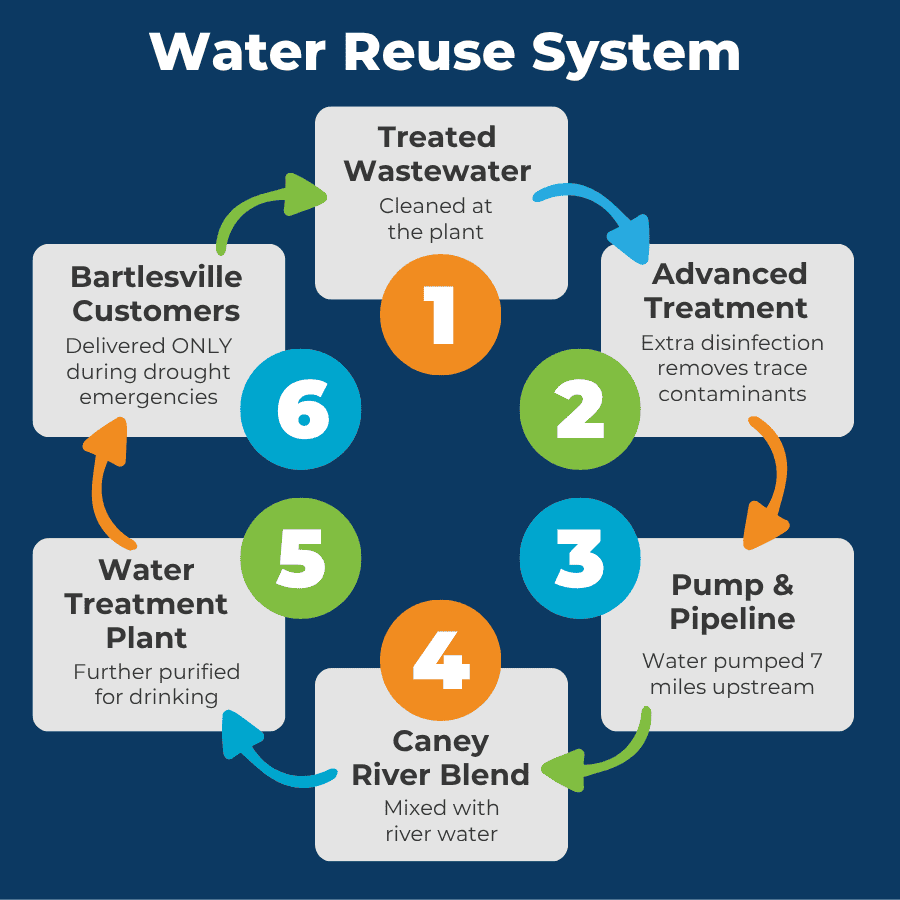
The water reuse system involves the construction/installation of additional treatment units to booster disinfection and target Contaminants of Emerging Concern, which are regulated trace contaminants found in wastewater, as well as infrastructure to pump and convey the water to the Caney River just south of the County Road West 1500 bridge. This will allow the City to pump treated wastewater approximately seven miles upstream of the Caney River Raw Water Intake and allow it to blend with existing river water, then send it to the water treatment plant for further treatment and, from there, to Bartlesville water customers during a water supply crisis.
This system, which is vital for the area to guard against drought in the future, will give the City access to up to four million gallons of water per day of additional water during extreme drought conditions and should meet area water needs 30 years into the future, with the potential to extend area water resources another 60-70 years, depending on demand.
Cities across the nation struggle with identifying and funding long-term water supply, including many in Oklahoma. For instance, the City of Enid built a 75-mile pipeline to Kaw Lake for long-term water supply at an estimated cost of $360 million funded by a 1 percent sales tax increase, making it the largest municipal water project ever undertaken in Oklahoma.
The cost to purchase additional storage contracts from the U.S. Army Corp of Engineers is $44.2 million for 16.76 mgd. However, this cost was based on 2006 storage rates. Since the formula prescribed by the Corps of Engineers policy includes an interest component, the estimated cost of these storage contracts, if purchased today, is more than $60 million. Combined with a pipeline from Copan Lake, the estimated overall cost of PAS recommendations is more than $100 million and correlates to a unit price of $6 million per mgd. The cost of water reuse is $14 million for 4 mgd, which correlates to $3.5 million per mgd.
Improvements to the water and wastewater systems are financed and repaid through utility rates.
It is important to note the water reuse system is for backup purposes only and would not be used unless all other water resources are compromised.


WHERE WE ARE TODAY
Since the early 1990s, the City has made substantial investments to improve the wastewater system and eliminate bypasses, or instances where wastewater leaves the collection system before treatment. To date, more than $43 million has been spent addressing these issues.
Through ongoing studies and completed projects, most system capacity problems have been resolved, leaving the treatment plant and several pump stations along the Caney River corridor as the remaining major bottlenecks.
A facility plan completed in 2010 identified the necessary improvements, and this plan was updated in 2017. Over the past 25 years, the ODEQ has used consent orders to ensure the City identifies and corrects capacity limitations. The current consent order, issued in 2020 and amended in November 2023 and 2026, requires the City to expand and renovate the wastewater treatment plant in accordance with the facility plan, as well as upgrade pump stations along the Caney River corridor.
Construction is set to begin on the WWTP expansion in June 2027, with completion anticipated by September 2031. Construction on the pump stations along the Caney River is set to begin in June 2030, with completion anticipated by January 2033.
For more information, contact the Water Utilities Department at 918.338.4116.